
Porn Addiction vs CSBD: What’s the Difference?
Porn Addiction vs CSBD: What’s the Difference?

People often use the terms “porn addiction” and “Compulsive Sexual Behaviour Disorder (CSBD)” to describe similar experiences. Both may involve repeated sexual behaviours that feel difficult to control. However, they are not exactly the same, and understanding the difference matters.
You might watch pornography more often than you intended, repeatedly try to stop, or feel frustrated because the behaviour is affecting your daily routine. You may describe yourself as addicted to porn. Someone else might experience a wider pattern of repetitive sexual behaviours, such as compulsive pornography use, repeated sexual encounters or other sexual activities that feel difficult to control.
But does this automatically mean you have CSBD? No.
Porn addiction is a commonly used, informal term, while CSBD is a recognised diagnosis in the World Health Organization’s International Classification of Diseases, 11th Revision (ICD-11).
This article explains what each term means, how they overlap, the signs of problematic pornography use, and when professional support may be helpful.
What Is Porn Addiction?
“Porn addiction” is a term people commonly use when they feel unable to control their pornography use. They may spend more time watching than they planned, repeatedly attempt to stop, or continue watching despite problems in their relationships, work, studies, sleep or emotional wellbeing.
For example, someone might decide to stop watching pornography but find themselves returning to it whenever they feel bored, lonely or stressed. They may spend hours searching for content, even when they no longer find the experience satisfying.
The word addiction is often used to describe this loss of control. However, it is important to understand that porn addiction is not currently a separate formal diagnosis in the ICD-11 or DSM-5-TR.
Researchers use other terms, including problematic pornography use (PPU), to describe pornography use associated with impaired control, distress or negative consequences. PPU is an area of ongoing research and clinical discussion. It is not automatically a diagnosis of CSBD.
Some people use pornography frequently without experiencing impaired control or significant problems in their lives. Others may use it less frequently but still feel distressed or struggle to control the behaviour. Frequency alone does not establish whether pornography use is problematic.
A useful way to understand the term is that porn addiction describes how a person may experience their relationship with pornography, rather than providing a diagnosis by itself.
What Is Compulsive Sexual Behaviour Disorder (CSBD)?
Compulsive Sexual Behaviour Disorder is a recognised condition in the World Health Organization’s ICD-11. It is classified under impulse control disorders, rather than disorders due to addictive behaviours.
According to the WHO classification, CSBD involves a persistent pattern of failure to control intense, repetitive sexual impulses or urges that results in repetitive sexual behaviour.
This behaviour may become so central to someone’s life that they neglect responsibilities, health, personal care or other interests. They may make repeated unsuccessful attempts to reduce the behaviour, continue despite negative consequences, or carry on even when they receive little or no satisfaction from it.
The pattern must generally persist over an extended period, such as six months or more, and cause significant distress or impairment in important areas of life.
CSBD can involve different types of repetitive sexual behaviour. These may include:
-
Repeated pornography use that feels difficult to control.
-
Repetitive sexual encounters.
-
Repeated masturbation that interferes with daily responsibilities.
-
Other sexual activities that become difficult to regulate.
Pornography use can therefore be part of CSBD, but CSBD is not limited to pornography.
It is also important to understand that having a high sex drive, frequent sexual thoughts or frequent sexual activity does not automatically mean someone has CSBD. The central issue is a persistent difficulty controlling the behaviour and the resulting impact on the person’s life.
For further clinical context, read the World Health Organization’s ICD-11 information and the peer-reviewed article What Should Be Included in the Criteria for Compulsive Sexual Behavior Disorder?.
Porn Addiction vs CSBD: What Is the Difference?
The main difference is that porn addiction is a commonly used, informal term focused specifically on pornography, while CSBD is a formal clinical diagnosis covering a broader pattern of repetitive sexual behaviour.
Here is a simple comparison:
| Porn addiction | CSBD |
|---|---|
| Common, informal term | Recognised ICD-11 diagnosis |
| Specifically refers to perceived problems with pornography use | Can involve several types of repetitive sexual behaviour |
| Not a separate formal diagnosis in ICD-11 | Classified as an impulse control disorder |
| Often used by people to describe feeling unable to stop watching porn | Requires assessment of persistent impaired control and significant distress or impairment |
| May describe problematic pornography use | May include problematic pornography use as part of the broader pattern |
|—|—|
There is some overlap between the two. A person who describes themselves as having a porn addiction may meet the criteria for CSBD, particularly when pornography use is part of a wider pattern of repetitive sexual behaviour.
However, not everyone who believes they are addicted to pornography will meet the diagnostic requirements for CSBD.
Similarly, someone can experience CSBD without pornography being their primary behaviour.
A clinical review published in Sexual Medicine Reviews explains why careful assessment is important. It highlights that pornography frequency alone cannot reliably establish a control problem and that clinicians need to consider the person’s behaviour, consequences and reasons for distress.
Read the review: Assessment and Treatment of Compulsive Sexual Behavior Disorder: A Sexual Medicine Perspective.
7 Signs of Problematic Pornography Use
Not everyone who watches pornography experiences problems. However, certain patterns may suggest that your use is becoming difficult to manage.
These signs do not independently diagnose an addiction or CSBD. They can help you decide whether it may be useful to examine your behaviour more closely.
1. You Repeatedly Try to Stop but Cannot
You might have decided several times that you want to stop watching pornography. You may delete bookmarks, uninstall apps or promise yourself that you will not visit certain websites again.
However, after a few days or weeks, you return to the same behaviour.
Repeated unsuccessful attempts to reduce or control sexual behaviour are relevant to a CSBD assessment. What matters is the persistent pattern, rather than one unsuccessful attempt.
2. You Spend More Time Watching Than Intended
You might plan to watch for a few minutes but end up spending an hour or more browsing different websites.
This can affect your sleep, productivity, studies, work or personal responsibilities.
The amount of time spent is not enough by itself to establish a disorder. However, repeatedly losing control over the time you spend and neglecting important activities may indicate a problem.
3. You Continue Despite Negative Consequences
You may notice that pornography use is affecting your relationship, concentration, sleep or daily routine.
Even after recognising these consequences, you continue engaging in the behaviour.
For example, you might repeatedly stay awake late at night watching pornography despite feeling exhausted at work the following day.
Continuing a repetitive sexual behaviour despite significant negative consequences is one of the patterns considered in CSBD assessment.
4. You Use Pornography to Manage Emotions
Sometimes pornography becomes a way to distract yourself from uncomfortable emotions.
You might watch when you feel:
-
Stressed after work.
-
Lonely or disconnected.
-
Bored during free time.
-
Anxious about a situation.
-
Frustrated or disappointed.
You may not be watching because you particularly want sexual stimulation. Instead, you may be looking for temporary relief or distraction.
Emotional coping can be relevant when understanding problematic pornography use, although using pornography to manage stress is not, by itself, a diagnostic criterion for CSBD.
5. You Neglect Other Responsibilities
Pornography use may start taking priority over other areas of your life.
You might cancel plans, delay important tasks, avoid social activities or spend less time with people close to you.
For example, you may repeatedly choose to stay alone and watch pornography instead of attending an event or completing work that needs your attention.
When repetitive sexual behaviour becomes a central focus and other responsibilities are neglected, it may be a reason to seek professional assessment.
6. You Continue Even When You Get Little Satisfaction
You might notice that watching pornography no longer feels particularly enjoyable.
You spend time searching for something interesting, switch between videos or continue browsing without feeling satisfied.
Despite this, you keep returning to the behaviour.
The ICD-11 description of CSBD includes continuing repetitive sexual behaviour even when the person derives little or no satisfaction from it. However, this feature must be considered alongside the other diagnostic requirements.
7. You Feel Unable to Make Choices About Your Behaviour
You may feel that pornography use is happening automatically.
For example, you might open a website without consciously deciding to do so, especially when you are alone, bored or using your phone late at night.
You may feel that your intentions and actions are repeatedly out of alignment.
This sense of reduced control can be worth exploring, particularly when it is persistent and affects your everyday functioning.
Does Watching Porn Every Day Mean You Have CSBD?
No. Watching pornography every day does not automatically mean that you have CSBD or a porn addiction.
Frequency is only one part of understanding a person’s behaviour. Someone may watch pornography regularly without experiencing impaired control, significant distress or disruption to their daily life.
Another person may watch less frequently but experience a persistent inability to control the behaviour and significant negative consequences.
A proper assessment considers several factors:
-
Whether you repeatedly struggle to control the behaviour.
-
Whether you have made unsuccessful attempts to reduce it.
-
Whether it interferes with responsibilities or relationships.
-
Whether you continue despite negative consequences.
-
Whether the pattern has persisted over an extended period.
-
Whether the distress is related to impaired control or another source.
It is therefore not helpful to diagnose yourself based only on how many times you watch pornography in a week.
If you are concerned, a qualified mental health professional can help you understand the pattern without making assumptions based on frequency alone.
What Is Moral Incongruence, and Why Does It Matter?
One important issue when discussing porn addiction and CSBD is moral incongruence.
Moral incongruence happens when a person’s behaviour conflicts with their personal, religious, cultural or ethical beliefs.
For example, someone may believe that pornography is wrong and feel guilty whenever they watch it. They might describe themselves as addicted even if they do not experience a persistent inability to control the behaviour or significant disruption to their daily life.
This does not mean their distress is fake or unimportant. Their feelings deserve to be taken seriously.
However, distress caused entirely by moral judgments or disapproval is not sufficient for a CSBD diagnosis under the ICD-11.
It is also possible for both issues to exist together. Someone may genuinely struggle to control pornography use while also feeling that the behaviour conflicts with their values.
This distinction matters because the support a person needs may differ.
Someone experiencing moral conflict may benefit from exploring their beliefs, expectations, shame and personal boundaries with a supportive professional. Someone experiencing persistent impaired control may need help addressing behavioural patterns and their consequences. Some people may need support with both.
For further reading, see the research article What Should Be Included in the Criteria for Compulsive Sexual Behavior Disorder?.
How Are Porn Addiction and CSBD Assessed?
A mental health professional will not diagnose CSBD simply because someone watches pornography or says they are addicted.
An assessment generally involves understanding the person’s sexual behaviour, ability to control it, duration of the pattern, distress and impact on daily life.
A professional may ask questions such as:
-
When did you first notice that the behaviour was becoming difficult to control?
-
Have you repeatedly tried to reduce or stop it?
-
How much time does it take up?
-
Does it affect your work, studies, sleep or relationships?
-
Do you continue despite negative consequences?
-
Do you experience little satisfaction but continue anyway?
-
Is your distress mainly related to personal or religious beliefs, or are there also difficulties controlling the behaviour?
They may also explore other factors that could contribute to the situation, including anxiety, depression, stress, substance use, relationship difficulties or other mental health concerns.
There is no single online quiz that can reliably diagnose CSBD. Questionnaires may help with screening or understanding symptoms, but they are not a substitute for a proper clinical assessment.
The purpose of an assessment is not to label someone. It is to understand what is happening and identify the most appropriate support.
How Can You Manage Problematic Pornography Use?
Whether you describe your experience as porn addiction or problematic pornography use, there are practical steps that may help you regain a sense of control.
These strategies are not a substitute for professional treatment when CSBD or another mental health concern is present. However, they can be useful starting points.
1. Understand Your Triggers
Start by noticing when you usually feel the urge to watch pornography.
Is it late at night? When you are alone? After a stressful day? When you are bored or avoiding an important task?
Try recording the situation, your emotions and what happened before the urge.
Understanding these patterns can help you identify situations in which you may need additional support or a different routine.
2. Change Your Environment
If you usually watch pornography in a particular place or at a particular time, make small changes to your surroundings.
For example:
-
Keep your phone away from your bed.
-
Avoid taking your phone into the bathroom.
-
Reduce late-night scrolling.
-
Unfollow accounts that regularly trigger unwanted urges.
-
Spend more time in shared spaces if being alone is a common trigger.
The aim is to make automatic behaviour less convenient and create more opportunities to make a conscious choice.
3. Set Digital Boundaries
If pornography is easily accessible, consider using website blockers, app restrictions or device-level controls.
You can remove saved links, clear triggering recommendations and limit access to websites that you repeatedly visit.
Tools such as BlockerX can help users block unwanted websites and create digital boundaries.
A blocker is a practical support tool, not a treatment for CSBD. It works best as part of a broader plan that also addresses habits, emotions and underlying difficulties.
4. Develop Alternative Ways to Cope
If you regularly turn to pornography when you feel stressed, lonely or bored, consider what you actually need in those moments.
You might need rest, social connection, exercise or a break from work.
Try alternatives such as:
-
Going for a short walk.
-
Calling a friend.
-
Exercising or stretching.
-
Reading or listening to music.
-
Practising a relaxation technique.
-
Working on a hobby.
You do not need to find one perfect replacement. Experiment with activities that fit your daily routine.
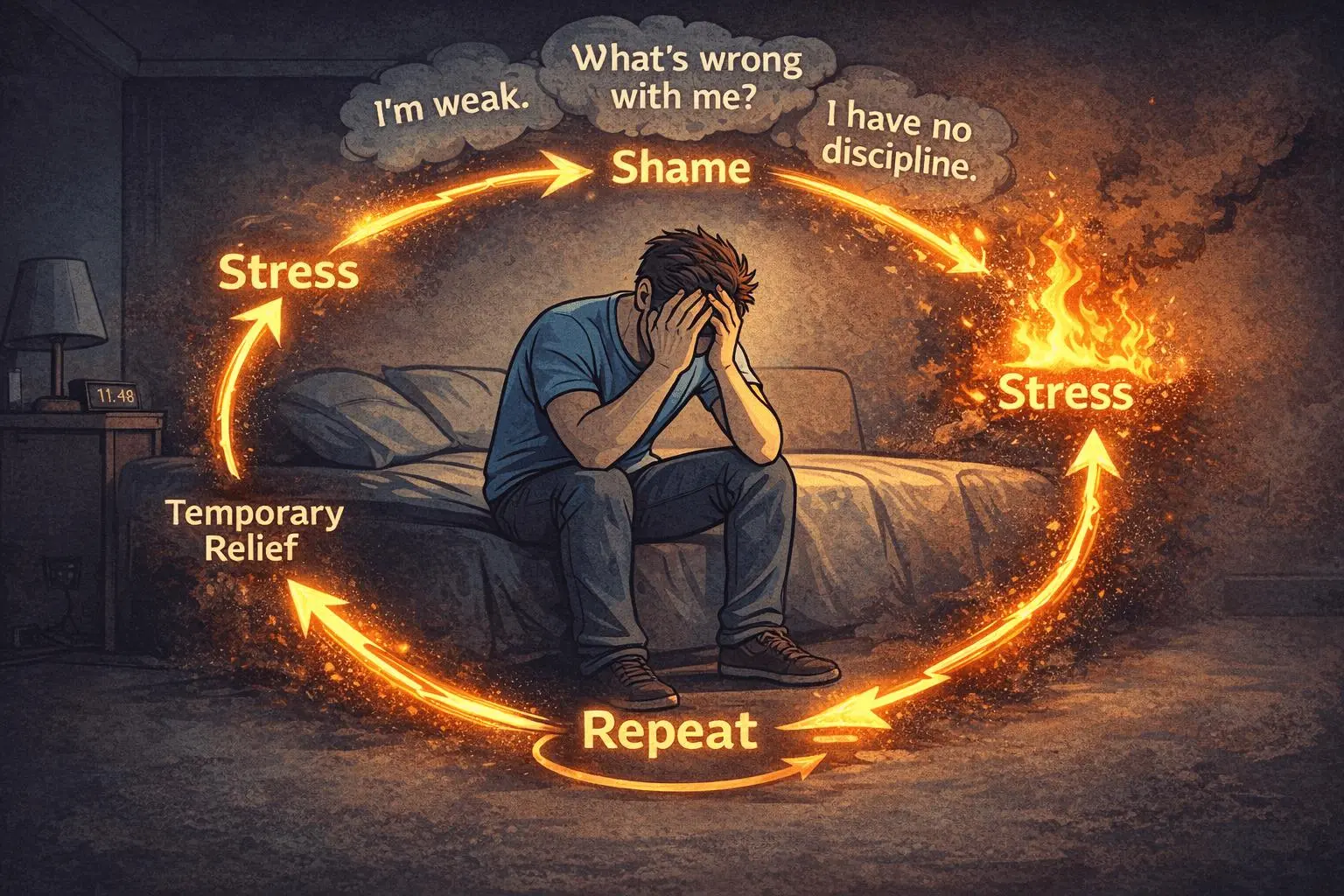
5. Avoid Using Shame as Motivation
Feeling guilty after watching pornography may make you want to change, but constantly criticising yourself is unlikely to help you understand the behaviour.
If you experience a setback, try to examine what happened.
Were you tired? Stressed? Alone? Did you spend hours scrolling on your phone?
Use the experience to adjust your plan instead of treating it as proof that change is impossible.
6. Seek Professional Support
If you repeatedly struggle to control your behaviour or it is affecting your relationships, work, studies, sleep or emotional wellbeing, consider speaking with a qualified mental health professional.
Psychological approaches such as Cognitive Behavioural Therapy (CBT) and Acceptance and Commitment Therapy (ACT) have been explored in the treatment of problematic pornography use and compulsive sexual behaviour.
A therapist can help you understand triggers, manage urges, work through emotional difficulties and develop strategies that fit your circumstances.
You do not need to wait until the situation becomes severe before asking for help.
Frequently Asked Questions
Is Porn Addiction the Same as CSBD?
No. Porn addiction is an informal term commonly used to describe difficulty controlling pornography use. CSBD is a recognised ICD-11 diagnosis involving a persistent pattern of failure to control repetitive sexual behaviour that causes significant distress or impairment.
Is Porn Addiction a Real Medical Diagnosis?
The term porn addiction is widely used, but it is not a separate formal diagnosis in the ICD-11 or DSM-5-TR. Researchers and clinicians often use terms such as problematic pornography use. A professional assessment is needed to understand whether someone’s symptoms meet the criteria for CSBD or another condition.
How Long Does It Take to Recover From CSBD?
There is no fixed recovery timeline. Progress depends on the person’s circumstances, the severity and duration of the difficulties, co-occurring concerns and the support they receive. Treatment often focuses on improving control, reducing harmful consequences and developing healthier ways to manage urges and emotions.
Should I Stop Watching Porn Completely?
This may depend on your particular situation. In some cases you may want to completely stop watching porn, and in others reduce or alter the behaviour. If you are undergoing any treatment, talk to your mental health professional to decide what is best for you.
Summary
Porn addiction and Compulsive Sexual Behaviour Disorder are closely linked, but slightly different.
Porn addiction is informally used to describe a lack of control with porn usage. Compulsive Sexual Behaviour Disorder is a clinical diagnosis that involves ongoing difficulties with controlling repeated sexual behaviour, significant levels of distress and impairment in functioning, and other key criteria.
Frequent consumption of pornography does not necessarily mean that you have a disorder. However, it is still helpful to seek support even if you have not developed severe issues.
Consider
Consider why this may be occurring, how it is affecting you, and whether you are making choices.
If you are struggling, getting support from a qualified professional will give a good understanding of the situation and help you to move forward in a suitable way. It is important to know that no matter what behaviour you are trying to change, it does not define who you are as a person.