What to Do About AI Deepfake Porn: 8 Essential Steps to Protect Yourself
What to do about AI deepfake porn:
Seeing content which seems to show you can be very distressing. Please note that although you may have contributed to the creation or circulation of content, you are not to blame for the abuse which occurs. Blame should lie with those who create, threaten and/or circulate content without your permission.
It is unnecessary to confirm whether content is genuine prior to seeking help. Fake, or artificial, content can still infringe someone’s privacy and put them at risk. Below is information on what to do, how to report and remove content, and how the provision of help differs for children and adults. Advice is also given on how to deal with a situation where someone is using content to threaten you.
Whilst laws and reporting bodies differ between countries, the following relates to the current federal laws in the United States. These are backed by a specific law. Those living in other countries should also check with their local online safety, child protection and/or police and victim support bodies.

In this guide
- 1. Consider your safety
- 2. Retain information but avoid circulation of content
- 3. Report the content to each relevant platform
- 4. Access an age-appropriate content deletion service
- 5. Understand the effectiveness and scope of hashing and search content deletion
- 6. Do not pay or send further content if the image is used in sextortion
- 7. Secure and control your online presence
- 8. Obtain support for the effects of the content
- Common misconceptions about AI sexual deepfakes
- Frequently asked questions
- Conclusion
1. SAVE RELEVANT DETAILSRecord links, usernames, dates, times and messages. Do not circulate intimate content.
↓
2. REPORT WHERE IT APPEARSUse the platform’s reporting process for each post or account.
↓
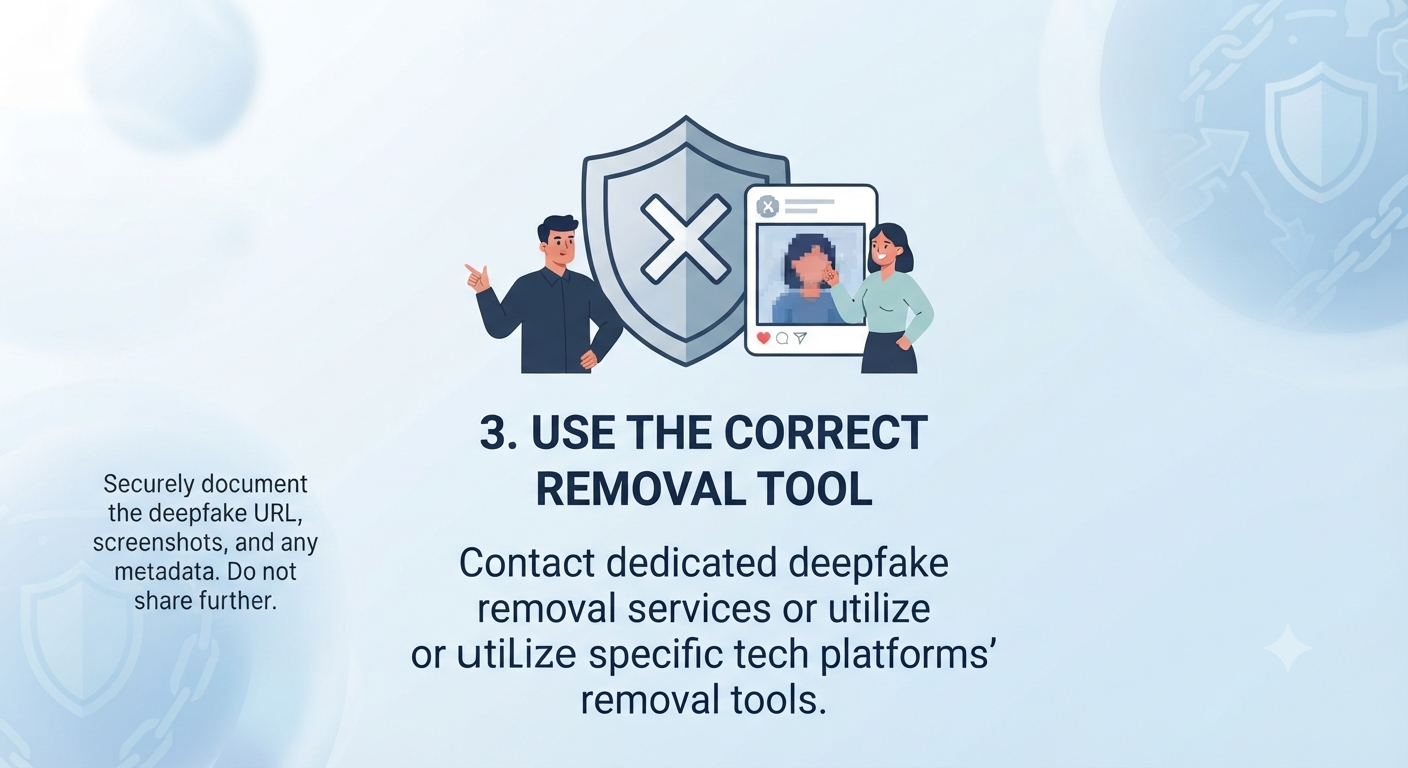
3. USE THE RIGHT REMOVAL TOOLChoose Take It Down for content created when the person was under 18, or StopNCII for adult content.
↓
4. GET SUPPORTContact a trusted person, victim-support organisation or appropriate authority.
What to do about AI deepfake porn
1. Consider your safety
If someone is threatening you, attempting to meet you, asking for money or claiming to know where you live or study then this should be treated seriously. Seek somewhere which makes you feel safer and approach someone you trust. Where there is imminent risk, contact local emergency services.
If you are under 18 then inform a trusted adult as soon as possible. Ideally this should be somebody who can remain composed and assist you to report the issue. This could be a parent or carer, school counsellor, teacher and/or other trusted adult. If the initial person is unable to assist then inform another. Children can and do become victims of sexual deepfake content. They should not have to deal with this alone.
When helping someone, listen before questioning them. Statements such as ‘I believe you’, ‘you are not to blame’ and ‘we can work through this step-by-step’ are often more effective than asking why the person photographed or placed their trust in someone. Avoid sending content as evidence as this can further circulate it and also potentially present legal issues. Particularly if the content includes a child, this should be avoided.
2. Retain information but avoid circulation of content
Wherever it is safe to do so, gather information to enable a platform and/or investigator to identify content. This can include usernames, links to posts, platform names, dates and times, and details of any messages. Screenshots may also be of assistance. However, do not circulate content to friends, in groups or to other sites. Also, avoid downloading and storing sexualised content which includes a child.
Maintain a brief history of events together with information relating to reports. This should comprise a report reference number, details of the platform’s response and when follow-up occurred. Should content be removed before you can capture a link or username, write down your recollection and retain any relevant details.
Never attempt to negotiate with the content creator if you feel that you are not safe. Likewise, do not retaliate or publicly reveal the identity of the content creator until you have received advice. Publicly confronting someone can increase awareness of your content. It can also notify them that you are reporting them and so encourage them to delete evidence. Further, it can expose you to further harassment. A trusted adult, solicitor, victim advocate and/or law enforcement body can advise on how to proceed.
3. Report the content to each relevant platform
Use a platform’s existing reporting function to report content which is non-consensual, sexually exploitative and/or which is fake. If content is present on multiple platforms then report each link or username in turn. Provide the precise link and explain that the content is non-consensual and seemingly shows you. Supply any relevant identifying and age information, again using a platform’s secure reporting method.
In the United States, the TAKE IT DOWN Act compels relevant platforms to establish a method for individuals to request deletion of non-consensual sexual content together with some fake content and deepfakes. Relevant platforms must delete suitable content and recognised duplicates within 48 hours of receiving a legitimate report. The Federal Trade Commission clarifies how this ‘notice and take down’ procedure operates: https://consumer.ftc.gov/consumer-alerts/2026/05/what-will-ftcs-enforcement-take-it-down-act-mean-you.
Please note that this is US-specific legislation and accordingly does not stipulate a global timeframe. Further, even after requesting deletion, it is not assured that all versions of content will be deleted from all sites, encrypted groups and/or sites which are not included within the law’s scope. Continue to store information and to report new instances of content.
4. Access an age-appropriate content deletion service
Hashing is a process which analyses and produces a computerised ‘fingerprint’ for particular content. Relevant platforms can then analyse this to recognise equivalent content. Although such systems can be effective at curbing circulation, neither do they ensure all versions of content are deleted from the internet and cannot prevent a new deepfake being produced from a standard photograph.
- If your content or video was created when you were under 18 then NCMEC’s Take It Down provides a free service. As stated by NCMEC, whilst this is analysing content a person retains possession of it and no upload occurs. The system works with relevant open and non-encrypted platforms.
- If your content/video was produced when you were 18 years of age or above then StopNCII.org is a free adult service. Again, a computerised fingerprint is analysed on a person’s device and this data is shared with relevant platforms. Review the guidance and list of relevant platforms prior to utilisation.
Do not pay people to ‘check’, ‘delete’ or ‘investigate’ content for you. The FBI cautions against such commercial sextortion services: https://www.fbi.gov/how-we-can-help-you/common-frauds-and-scams/sextortion/sextortion. Instead, use either the aforementioned services or a trusted victim support body and adhere to their guidelines regarding what can be reported.
5. Understand the effectiveness and scope of hashing and search content deletion
Hashing can be effective if it is age-appropriate and content conforms to a system’s criteria. However, it is generally restricted to relevant platforms. Further, modified, trimmed or freshly produced content may not correspond with a content’s original fingerprint. In addition, encrypted platforms may not be accessible via hashing.
Should content surface in a search engine, in addition to reporting it to the relevant site, also report it to the search engine. Although deleting content from a search engine can hinder its discoverability, it does not necessarily mean that the underlying file is also deleted from the relevant site. Both actions may be necessary.
If you do not have access to content then do not request that the content producer or a friend sends it to you in order that you can utilise hashing. Contact the relevant hashing service or a victim advocate to explore alternative methods of action. It is explicitly stated on the Take It Down website that individuals should only analyse content which they themselves hold. Neither downloading nor sharing content should occur for this purpose.
6. Do not pay or send further content if the image is used in sextortion
Sextortion is where someone threatens to circulate sexualised content unless the target person pays money, transmits extra content or performs another action. The perpetrator may even falsely suggest that they have already distributed content to friends, school or family members. Although you may wish to assess whether or not this is true, you do not need to do so yourself.
Both the FBI and the National Center for Missing & Exploited Children (NCMEC) recommend that victims do not transmit further content or pay money and that they seek assistance. Payment is not consistently successful in ceasing sextortion threats and can even provoke further ones. Wherever it is safe to do so, evidence of sextortion should be retained. Report the relevant username to a platform and consult local law enforcement and/or the relevant child protection reporting body. Within the United States, if the victim is a child then NCMEC provides the CyberTipline which can facilitate both reporting and offer support.
Even if you have already paid or sent something you can still seek assistance. Do not allow personal feelings of shame to deter you from doing so. Share information regarding your circumstances with a trusted individual or agency. Their role is to support you and to record details of the abuse – they are not there to accuse you.
7. Secure and control your online presence
Alongside gathering information, examine and update relevant online accounts. Alter passwords on trusted devices, activate multi-factor verification and check details for email and telephone number recovery. Also log-out of unfamiliar sessions. Temporarily set social media accounts to private where this is felt to be beneficial. Following information gathering and reporting, it may be appropriate to block the content producer.
Only disclose information to schools, employers and/or family where this is felt to be necessary for your safety or to avert an identifiable risk. People are not obliged to receive detailed information about your experience. When informing others of a threat, supply them with just sufficient information. Avoid sharing sexualised content.
8. Obtain support for the effects of the content
Non-consensual sexual deepfakes can induce feelings of fear, rage, shame and/or affect a person’s concentration and relationships, as well as their perception of themselves. Individuals can be impacted in many ways. You do not need to have a formal diagnosis or confirmation that your content has widely circulated in order to require support.
Licensed professionals, sexual assault advocates, school counsellors and/or victim support bodies can all assist with managing your emotional wellbeing and advising on future action. Should you feel that a source of support is inappropriate then request a transfer to another. Although online resources can be helpful, a trusted person can also provide crucial support to ground you during the reporting phase.

Within families, discussions should be maintained in a supportive and non-reproachful manner. BlockerX has produced a parental sex education and discussion guide which may act as a good basis for exploring children’s online experiences, consent and sources of support.
Common misconceptions about AI sexual deepfakes
“It is fake, so it cannot hurt anyone.” Despite being artificial, content can still be utilised to embarrass, threaten, impersonate and/or bully a genuine individual. The non-existence of authentic sexualised content does not equate to non-harm.
‘As the person had online images then they consented to the production and/or distribution of sexualised content.’ Having publicly available images does not equate to consenting to the production and/or circulation of sexualised images. Nor does permission for one form of image usage extend to another.
‘Hashing will delete all content.’ Although hashing can aid relevant platforms in identifying equivalent content, it is not universally applicable and cannot ensure that all altered versions are deleted.
‘The victim should independently address deletion of content.’ Apart from the victim, other sources of support such as trusted adults, advocates, platform safety bodies, law enforcement and/or victim support bodies can all provide assistance. Particularly for children, they should not have to independently manage this process.
Frequently asked questions
What should I do if I am the subject of sexual deepfake content?
Ensure that you are safe. Inform a trusted person and, if safe to do so, gather information including the post link and sextortion details. Report the content to a platform. Further, if you are under 18 then engage the aid of a trusted adult and use age-appropriate reporting mechanisms.
Can I delete AI deepfake content?
Content can be reported to and requested for deletion by a platform. Within the United States, relevant platforms must delete suitable content within 48 hours of a legitimate deletion request under the TAKE IT DOWN Act. Hashing can also support platforms in identifying equivalent content. Nonetheless, none of these procedures absolutely ensure that all versions of content will be deleted from all locations.
Is Take It Down for adults?
Take It Down is aimed at those whose content or video was produced when they were under 18. Adults can check StopNCII’s suitability guidance for those whose content/video was produced when they were 18 years or older or above.
Should I pay people to delete my deepfake content?
Beware of those who charge for content deletion and/or offer absolute deletion assurance. The FBI also cautions against commercial sextortion support: https://www.fbi.gov/how-we-can-help-you/common-frauds-and-scams/sextortion/sextortion. Official platform reporting mechanisms and recognised victim support bodies should be accessed.
What if content is only used for sextortion?
Record sextortion details. Avoid sending further content or money. Then obtain the support of a trusted person and/or local authority. Prior to content being posted, it is also possible to report an associated username.
Conclusion
When considering how to manage a situation involving AI deepfake pornography, consider safety together with sources of support. Safely gather information including links and sextortion details. Report content to relevant platforms. Use age-appropriate support mechanisms. And seek support if you are being threatened. Although deletion tools and legislation can be of assistance, these, again, have limitations and will also differ geographically.
Those depicted in content are not accountable for other people’s decisions to produce and/or circulate sexualised deepfake content. Everyone is entitled to support and to have their privacy and dignity respected.