You Don’t Have to Look for Porn Anymore — It Finds You

Reviewed
by – Dr.
Nick Nissen, MD
Dr. Nick Nissen is a clinical fellow at the Department of Psychiatry, Harvard Medical School.
His interests are treatment-resistant disorders and care management. He lectures on topics such
as mood disorders, sleep disorders, mindfulness, and addictions. He is also the host of the
Brain Health with Dr. Nissen Podcast and collectively has 90K+ followers across social media
platforms.
The Porn Problem on Social Media in 2026: 6 Platforms, Real Risks
Explicit content isn’t just on porn sites anymore — it’s baked into your feed. Here’s the updated 2026 breakdown of how X, TikTok, Instagram, Reddit, Discord & Snapchat actually handle adult content, and how to protect yourself or your kids.
Ten years ago, if you wanted porn, you went to a porn site. You typed a URL, maybe cleared your browser history, and it stayed in its own lane. That world doesn’t really exist anymore. In 2026, explicit content lives in the same feed as your friend’s birthday post, a recipe video, and a meme about your Monday — served up by the same algorithm that decides what keeps you scrolling.
That’s not an exaggeration for effect. It’s the actual architecture of how these platforms work now, and it changes the entire conversation about what “porn exposure” means for anyone under 18 scrolling next to you.
Wait — is porn actually allowed on these apps?

Depends entirely on which app, and the honest answer surprises most people.
X (formerly Twitter) is the outlier here — the only major mainstream platform that has gone the opposite direction from everyone else. In 2024, X formally updated its rules to permit “consensually produced adult content,” as long as it’s labeled and kept out of prominent spots like profile photos and banners. By 2026, that policy has only gotten more structured — creator classification requirements, automated NSFW detection that re-labels underclassified content, and age-verification layers for the most explicit material. In plain terms: X isn’t hiding from this anymore. It built rules around allowing it.
Instagram, Facebook, TikTok, and YouTube all still officially prohibit pornographic content outright. “Officially” is doing a lot of work in that sentence, and we’ll get into why below.
Reddit and Discord sit somewhere in between — both allow adult content in clearly marked spaces (NSFW subreddits, age-gated Discord servers) while banning it everywhere else, with enforcement that’s inconsistent at best.
Related article: 5 Precautions You Should Take Before You Let Your Kids Join Social Media
The gap between “banned” and “actually absent” is where the real problem lives
Here’s the uncomfortable truth every platform in the “we prohibit this” category has to sit with: policy on paper and what a 13-year-old’s feed actually looks like are two very different documents.
A Wall Street Journal investigation that set up test accounts registered as 13-to-15-year-olds found TikTok served those accounts hundreds of videos promoting paid porn sites and sex shops, alongside videos flagged “for adults only” — despite an official ban on exactly that content. Separately, reporting from the BBC and researchers tracking child exploitation have documented TikTok Live being used by minors to solicit and advertise sexual content, sometimes for payment.
Discord has faced its own reckoning — a 2025 lawsuit from the New Jersey attorney general alleged the platform’s default settings leave young users exposed to explicit content and vulnerable to predatory contact in unmoderated servers. Discord has since rolled out expanded reporting tools, including support for removing non-consensually shared explicit images under the U.S. TAKE IT DOWN Act, which took effect in May 2026.
The pattern across almost every platform: automated detection catches a lot, catches it too slowly, or gets outpaced by people who know exactly which coded hashtags and search terms slip past the filters that week.
Why this actually matters, not just morally — practically
It normalizes faster than you’d think. Repeated, casual exposure to sexual content in a feed built for quick dopamine hits recalibrates what feels “normal” surprisingly fast — especially for a developing brain that hasn’t built the context adults have.
Algorithms don’t know your age, they know your attention. These platforms don’t curate based on what’s appropriate — they curate based on what keeps you watching. If a young user lingers even a second too long on something borderline, the system reads that as a signal to show more of it, not less.
It’s a pipeline for predators, not just content. Beyond passive exposure, explicit content and DMs are a well-documented grooming vector — coded language, “performance” requests, and direct solicitation have all been documented on TikTok, Discord, and Snapchat specifically involving minors.
It quietly reshapes expectations. For anyone consuming this content regularly, algorithmically-fed sexual content trains a different baseline for what intimacy and bodies are “supposed” to look like — one that has nothing to do with real relationships.
Platform-by-platform: what’s actually going on in 2026
X — the platform that stopped pretending
X is now the most permissive mainstream platform by policy, not by accident. Its Adult Content Policy explicitly allows consensual NSFW material, provided it’s labeled and not placed somewhere highly visible. Automated detection scans uploads and escalates penalties for creators who under-label. It’s a more structured system than the old “anything goes if nobody complains” era — but structure isn’t the same as absence, and this remains the easiest mainstream platform to stumble into explicit content on, intentionally or not.
TikTok — the algorithm problem, concentrated
TikTok bans pornographic content outright in its community guidelines. In practice, its “For You” recommendation engine — which learns from hesitation and rewatches, not just likes — has repeatedly been shown to funnel sexual and adult-adjacent content toward accounts registered as minors, according to independent testing and investigative reporting. TikTok has pointed to parental controls and automated moderation in response, but researchers and child-safety groups have continued flagging gaps, particularly around TikTok Live.
Instagram — bots, hashtags, and the “grey zone”
Instagram’s nudity policy remains one of the strictest on paper — even artistic nudity is technically prohibited. In practice, coded hashtags, DM-based promotion, and a persistent population of “porn bot” accounts route real users toward explicit content or subscription platforms off-app. Meta’s enforcement has improved with better AI detection, but the underlying incentive — engagement-driven discovery — keeps creating fresh workarounds as fast as old ones get closed.
Reddit — deliberately, structurally open
Reddit is the most upfront about this of any major platform. Its leadership has been explicit that Reddit has no plans to ban adult content, framing NSFW communities as a legitimate, clearly-labeled space for topics other platforms won’t touch. The system relies on self-tagging and an 18+ content toggle in settings — which works reasonably well for anyone using it honestly, and not at all for anyone who isn’t.
Discord — the unmoderated-server problem
Discord’s core issue isn’t a lax content policy — it’s structural. Millions of independently-run servers, many with minimal moderation, make consistent enforcement close to impossible at scale. The 2025 New Jersey lawsuit specifically targeted default settings that made it too easy for minors to land in servers with explicit content or predatory DMs. Discord’s newer safety tooling is a real step, but it’s reactive by design — it removes content after a report, not before exposure happens.
Snapchat — built for content that’s supposed to disappear
Snapchat’s entire product logic — disappearing messages, screenshot notifications — makes it a uniquely attractive platform for sharing content people don’t want permanently traceable, adult content very much included. An entire secondary ecosystem of Snapchat-linked subscription and “finder” services has grown around this, operating largely adjacent to Snapchat’s own enforcement rather than inside it.
What you can actually do about it
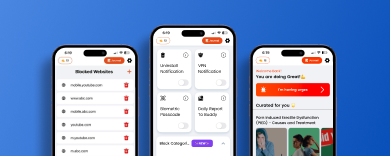
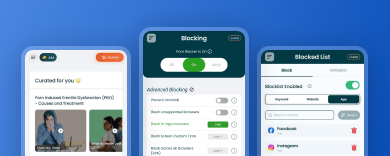
For yourself: A device-level content blocker that works across apps — not just a single platform’s in-app filter — closes the gap between “banned in the terms of service” and “actually blocked on my screen.” Most platform-native filters (X’s sensitive-content toggle, Reddit’s 18+ setting) are opt-in and trivially reversible, which makes them filters against accidental exposure, not real barriers.
For a kid in your life: Default-deny beats default-allow. Rather than trying to block every explicit site individually, set up parental controls that only permit apps you’ve specifically approved, and revisit that list as they get older. Talk openly about what they might encounter — kids who’ve been told what grooming and coded solicitation actually look like are measurably harder targets than kids who’ve been told nothing.
For anyone rebuilding a healthier relationship with any of this: blocking access is the first step, not the whole plan. Pair it with cutting down the apps that are the heaviest exposure sources for you specifically, and with something to actually fill the time and attention that opens up.
The bottom line
Social media platforms didn’t set out to become secondary porn distribution networks, but for a huge number of users — especially young ones — that’s functionally what they’ve become. The policies exist. The enforcement lags behind them, sometimes by a lot, and the algorithms that drive engagement don’t particularly care which side of that gap you’re standing on. Understanding platform-by-platform where the actual risk concentrates is the difference between vague worry and an actual plan — for yourself, or for someone you’re responsible for protecting.
Our experts continually monitor the health and wellness space, and we
update our articles when new information becomes available.
- Current Version
Dec 07, 2023Reviewed by
Dr. Nick Nissen, MD
Updated by
Deepak Sengar
- May 03, 2022
Written by
Nimmy Pious
Edited by
Chandraprabhudev K