What Actually Happens When You Don’t Ejaculate for 30 Days? A No-BS 2026 Guide
Not Ejaculating for 30 Days: Real Benefits, Science & Survival Guide (2026)
What actually happens when you don’t ejaculate for 30 days? Real research on testosterone, focus, and relapse triggers — no bro-science, no fluff. Your 2026 No Nut November guide.
Every November, the same joke resurfaces on every platform, half meme, half actual challenge, all group chat chaos. No Nut November has been a running bit since before most Gen Z users had their first phone. But underneath the meme format is a real question that a lot of people are quietly Googling in private: does this actually do anything, or is it just a 30-day dare with a funny name?
Let’s actually answer that. Not the group-chat version, the version backed by what research currently shows, minus the bro-science exaggeration that tends to flood this topic.
First, some numbers to put this in perspective
This isn’t a fringe habit you’re being weird about. Research indicates the average person ejaculates somewhere between two and seven times a week, and masturbation shows up as a consistent part of life from the early teens well into the 70s and 80s for most men, according to data published in The Journal of Sexual Medicine. Meanwhile, frequency of partnered sex tends to decline with age far more sharply than solo activity does.
So no — deciding to pause this for 30 days isn’t some extreme act against your biology. It’s a deliberate, temporary choice layered on top of something your body does constantly anyway.
What the research actually supports (and what it doesn’t)
Let’s be upfront: the science here is real, but it’s early, and a lot of the internet’s confidence outpaces what’s actually been proven. Here’s the honest state of things.
Mental resilience — probably the strongest evidence
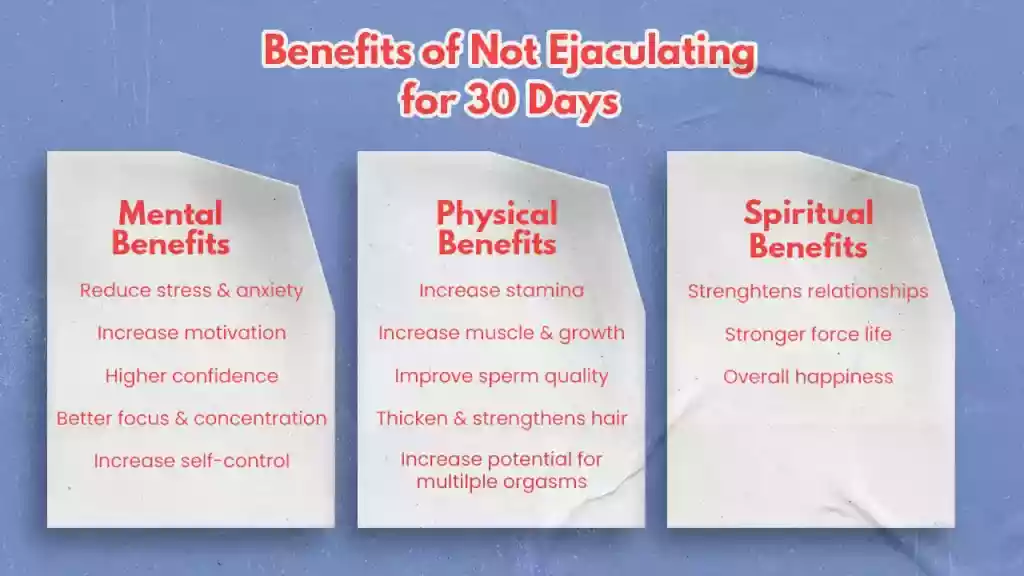
Choosing not to act on an urge for an extended stretch is, functionally, a discipline exercise. Deliberately sitting with discomfort instead of immediately resolving it is a documented way to build tolerance for delayed gratification — a skill that tends to bleed into other parts of life, from work focus to just generally not being ruled by every impulse that shows up. Several accounts also link the practice to lower reported stress and anxiety, likely tied to breaking a compulsive relief-seeking loop rather than anything mystical about semen itself.
Relationship perspective — underrated, rarely talked about
When orgasm stops being the default endpoint of every private or shared moment, people often report noticing other parts of a relationship more — actual conversation, time spent together, non-sexual affection. This isn’t backed by hard clinical data so much as consistent anecdotal reporting, but it lines up with basic behavioral logic: remove a default habit, and attention naturally redistributes somewhere else.
Physical energy and testosterone — real, but overstated online
This is where hype tends to run ahead of evidence. A widely cited 2003 study found testosterone peaking specifically around day seven of abstinence — which is genuinely interesting, but it’s one study, over one week, not a guarantee of a monthlong testosterone climb or automatic “gains” in the gym. If you’re strength training during a 30-day stretch, any energy or motivation boost you feel is worth taking at face value without assuming it’s purely hormonal — sleep, diet, and mindset shifts during a discipline challenge like this tend to matter just as much.
Sperm health — more nuanced than most articles let on
A frequently cited 2018 study found a single day of abstinence associated with improved sperm motility, and testosterone/sperm count both trending upward specifically around day seven of abstinence. But — and this matters — other research has found that longer abstinence windows can come with a trade-off: increased semen volume and total count, alongside reduced sperm vitality. In other words, “not ejaculating = automatically healthier sperm” isn’t the settled conclusion it’s often presented as. If fertility is your actual concern, that nuance is worth knowing, and worth a real conversation with a doctor rather than a blog post.
The porn-standards reset — psychological, not physiological
For anyone who’s leaned on porn regularly, a full month without ejaculating (with or without porn in the picture) tends to force a recalibration of what arousal actually feels like without a screen setting the pace. This is less about the abstinence itself and more about breaking a specific stimulus-response loop that’s had time to root itself in — the 30 days is really a vehicle for that reset, not the mechanism on its own.

How to actually get through 30 days (without white-knuckling it)
Go day by day, not “30 days” as one giant wall. Committing to “today” is a fundamentally different mental task than committing to a month. Most people who quit early quit because they kept staring at the whole mountain instead of the next step.
Build real friction on your devices. A reliable content blocker — something covering your phone, laptop, and tablet — removes the split-second decision point where willpower is weakest. This isn’t cheating; it’s just good system design, the same logic behind putting your phone in another room while you study.
Redirect the freed-up time into something with actual momentum. A new skill, an instrument, a language, a sport — something that gives you a visible sense of progress by day 15 or 20. Boredom is one of the biggest relapse triggers, and an empty schedule is basically an open invitation.
Use the outdoors as an actual tool, not just a suggestion. When an urge spikes, a short walk changes your physical state fast — different scenery, different blood flow, different headspace. It sounds almost too simple, but removing yourself physically from the trigger environment works precisely because urges are time-limited; most fade within minutes if you don’t feed them.
After day 30: the part nobody warns you about
Finishing the challenge feels great for about 48 hours — and then the actual test starts. Here’s what tends to trip people up on the other side.
Know your triggers before they know you
Relapse rarely comes out of nowhere. It usually traces back to a specific category:
- Sexual triggers — explicit content, certain thoughts, a racing heartbeat that shows up before you’ve consciously registered why
- Emotional triggers — stress, sadness, boredom, even happiness; strong emotions of any kind tend to send the brain looking for a dopamine shortcut
- Physical triggers — an innocent touch or moment of closeness that spirals into something else
- Behavioral triggers — small habits like scrolling in bed late at night or bringing your phone into the bathroom, which quietly set the stage without feeling like a decision at all
Naming these in advance is the difference between getting blindsided and seeing it coming.
Counting days helps… until it doesn’t
Tracking a streak is genuinely motivating early on. But past a certain point — often somewhere around the two-to-three week mark — the goal shifts from “surviving day X” to actually rewiring the underlying habit loop so it stops running the show entirely. If you’re still white-knuckling every single day at day 25, that’s a signal the deeper habit hasn’t shifted yet, not that you’re failing.
Find your actual “why”
Discipline without a real reason behind it tends to collapse the moment things get inconvenient. Whether your reason is mental clarity, a relationship, self-respect, or just wanting your brain back from a loop you didn’t consciously choose — that reason needs to be something you can genuinely feel in the exact moment temptation shows up, not just something you wrote down once and forgot.
The bottom line
Thirty days without ejaculating isn’t a magic reset button, and anyone promising overnight transformation is overselling it. What the actual evidence — and a lot of consistent personal reporting — supports is more modest and, honestly, more useful: real gains in self-discipline, a clearer read on your own habits and triggers, and for a lot of people, a genuinely different relationship with arousal once a screen or a compulsive loop isn’t setting the terms anymore. That’s worth 30 days, meme or not.
Final Words
It might seem quite difficult to get through 30 days without ejaculating, especially if it is a part of your everyday routine. An essential aspect of the same is making sure you try your best to get through the challenge, despite the number of obstructions in your way.
And trust us when we say that the benefits of not ejaculating for 30 days, are definitely worth it.
Not Ejaculating for 30 Days – FAQs
Q1. Is semen retention the same as retrograde ejaculation?
Ans. No, semen retention and retrograde ejaculation are not the same thing. Unlike voluntary semen retention, retrograde ejaculation involves a unique physiological process, forming a difference between the two practices.
Q2. What is the main reason for premature ejaculation?
Ans. Generally, a phase of regular ejaculation may give way to acquired premature ejaculation. However, of course, there are other issues at hand, such as interpersonal issues, erectile dysfunction, performance anxiety, stress, or generalized anxiety.
Q3. Does semen retention lead to improved sperm quality?
Ans. Well, this is still a topic of debate; because according to some research and scientific evidence the ejaculatory abstinence period, does show an increase in semen volume and total sperm count but at the same time it also has shown reduced sperm vitality.