Social Media Age Restrictions Under 16: 2026 Parent Guide
Young people use social media to communicate, explore interests, and keep up with trends. As awareness of online risks grows, governments and families are weighing how children can use these services more safely.
Social media age restrictions under 16 are a subject of debate and policy change around the world. Some countries have introduced rules; others are developing or considering them. This guide explains the current position in Australia, the United Kingdom, and India as of 24 November 2026, and offers practical steps for parents.
Age limits are only one part of online safety. Children also need privacy awareness, supportive conversations, clear boundaries, and age-appropriate ways to stay connected with friends and family.

Whilst social media is now commonplace, young people engage with social media to communicate, explore new interests and keep up-to-date with current trends. With increasing awareness of online dangers, both governments and parents are exploring whether young people should be permitted full access to social media.
Social media age restrictions (under 16) are currently an area of global interest. Some countries have already put in place minimum age requirements for social media and others are exploring ways that they can.
Concerns often centre on the effect that social media can have on children in areas such as their mental health, privacy and susceptibility to cyberbullying, alongside their engagement with unsuitable content and the potentially addictive elements of social media.
Parents are keenly aware of these issues and so may wish to know:
At what age is it suitable for a child to engage with social media?
Can parents legally control children’s social media?
What if a child falsifies their age to set up a social media account?
How can parents effectively ensure a child’s safety online, whilst also enabling them to maintain friendships?
This guide outlines current policy changes, explains why they are being considered, and shares practical ways parents can support safer online participation.
What Are Social Media Age Restrictions Under 16?
Social media age restrictions under 16 can include laws, regulations, or platform rules that limit whether people below a specified age may create or keep accounts on certain social media services. The exact scope, age-check requirements, and responsibility differ by country.
These measures are intended to reduce particular risks and encourage safer online experiences during childhood and adolescence. Their effects and limits are still being debated and assessed.
They may include:
- Prohibiting those under 16 from setting up and continuing to use social media
- Requiring companies to strengthen age checking procedures
- Controlling which social media functions can be accessed
- Necessitating parental permission to engage with some online services
- Enhancing companies’ duty of care to young people
- Controlling and preventing the sharing of inappropriate content and recommendations
An age restriction on specified social media accounts does not necessarily prevent children from accessing the wider internet or every digital service.
Depending on local rules, services for education, messaging, gaming, and other purposes may be treated differently. Check the current law and official guidance for the relevant country.
The important distinction is between general internet access and access to a particular social media service or account.
Why Are Governments Exploring Social Media Age Restrictions for Children?
Concern about children’s online experiences includes exposure to unsuitable content, privacy risks, cyberbullying, sleep disruption, and features that encourage prolonged use. The evidence on mental health is complex: the National Academies’ 2024 review describes mixed findings and notes that many studies do not establish cause and effect. This is one reason policy debates also focus on platform design and safety measures.
Unsuitable content
Children can view violent, sexual and/or risky content along with information surrounding drug use and unattainable body images on social media.
Despite online content checks, unsuitable content can also be suggested, commented on, advertised and/or posted by users.
Young people may not always be mature enough to accurately analyse and avoid misleading and/or unsuitable content.
Cyberbullying
Although social media can be used for positive communication, it can also facilitate bullying.
Young people can suffer from unkind comments, shaming, threatening messages and even fake profiles. They can also be sent unwanted photographs and excluded from online groups.
Unlike school-based bullying, online bullying can occur at any time and even affect children in their own homes.
Comparisons and mental health
As teenagers form their identities, they are often keen to compare themselves with others.
Continual viewing of highly edited images, as well as information regarding others’ wealth, popularity and appearance, can lead to young people comparing themselves with others in an unhelpful manner.
Some young people judge their self-worth based upon the level of engagement (for example likes, followers and comments) that they receive.
This can then contribute to poor self-esteem, peer-related pressures and/or dissatisfaction with a child’s appearance and/or lifestyle.
Over-engagement and effects on sleep
Children can easily over-engage with online services due to features such as notifications, auto-play and recommended short video clips.
Later night social media engagement can also disturb children’s sleep.
Sleep can in turn affect a child’s concentration levels, emotional state and academic attainment, as well as their overall well-being.
Privacy and vulnerability
Young people can often fail to recognise how far information that they provide can be disseminated.
They may disclose details of where they study, their location, photographs, routine and/or family members.
Other potential dangers for children include unwelcome communications, grooming, fraud and manipulation.
Age restrictions are partly designed to allow children additional time to build up the maturity and digital know-how to engage safely online.
Which Countries Have Introduced Social Media Age Restrictions Under 16?
Social media age restrictions differ internationally. Some countries already have minimum age laws in place and others are exploring how they could establish such regulation.
The table and country summaries below reflect official information available as of 24 November 2026. These policies can change; check the linked regulator or government source for updates.
| Country | Status for under-16s | Key point |
|---|---|---|
| Australia | In force since 10 December 2025 | Covered platforms must take reasonable steps to prevent under-16 accounts. |
| United Kingdom | Announced; planned for Spring 2027 | First regulations are expected before the end of 2026; proposal not yet in force. |
| India | No general under-16 social media ban in force | DPDP child-data provisions are scheduled for May 2027 commencement. |
Australia: Under-16 Social Media Minimum Age
Australia has put in place amongst the most substantial social media age restrictions.
Australia’s Social Media Minimum Age obligation took effect on 10 December 2025. Covered services must take reasonable steps to stop Australians under 16 from creating or keeping accounts. The eSafety Commissioner explains the rules for families, including that the duty is on platforms and the covered-services list may change.
Covered platforms must take reasonable steps to prevent Australians under 16 from creating or keeping accounts on age-restricted social media services. The legal duty falls on the platforms; children and parents are not penalised under this minimum-age obligation for an under-16 account.
As of the eSafety Commissioner’s current list, covered services include Facebook, Instagram, TikTok, Snapchat, Reddit, Threads, X, YouTube, Twitch, and Kick. The list is determined by the law and may change; check the regulator’s current information rather than relying on a static list.
The obligation is placed on the relevant platforms, rather than punishing children or parents for an under-16 account.
Furthermore, the Australian eSafety Commissioner describes that despite age restrictions, children can still engage with a variety of online services such as communication, gaming and education and support provision.
United Kingdom: Proposed Under-16 Restriction
The UK Government has announced its intention to restrict social media services for under-16s. As of 24 November 2026, the proposal is not yet in force. The Government expects the first regulations before the end of 2026 and implementation in Spring 2027, subject to the legislative process. Read the current UK Government fact sheet and Ofcom’s age-check assessment.
This is partially inspired by the Australian system.
Whilst the government has confirmed that it wishes to prevent children under 16 engaging with selected social media services, it has also expressed intent to regulate damaging social media features such as live-streaming and communication with strangers.
As of 24 November 2026, the proposed under-16 restriction is not yet in force. The Government says the first regulations are expected before the end of 2026 and expects the restrictions to take effect in Spring 2027. Ofcom has assessed methods that may be considered highly effective for age checks, but the detailed rules and implementation remain in progress.
Parents should differentiate between the existing Online Safety Act provisions which seek to enhance online safety and the forthcoming social media age restrictions.
See the UK Government’s current fact sheet.
Ofcom has also published an assessment of age checks at 16.
India: What Parents Should Know
India has adopted a different approach to managing online safety.
As of 24 November 2026, India has not brought into force a general nationwide ban preventing under-16s from using social media.
However, India has legislation which protects children’s online privacy and safety.
India’s Digital Personal Data Protection Act, 2023 contains child-data safeguards, including verifiable parental consent requirements and restrictions on tracking or behavioural monitoring and targeted advertising to children. However, the official commencement notification schedules sections 7 to 10, including the child-data provisions, to take effect 18 months after 13 November 2025, in May 2027. These provisions are therefore not yet in force as of 24 November 2026; exemptions and detailed rules also apply. See the official Act commencement notification and the Digital Personal Data Protection Rules, 2025.
The Indian Government has also highlighted online safety concerns, including cyberbullying, inappropriate content, over-engagement, and digital dependency. These concerns do not amount to a nationwide under-16 social media ban.
Hence, even though there is no general India-wide under 16 social media ban, this does not imply that children should be permitted unlimited social media access. Parents should continue to use relevant online controls, talk to children about online safety, and manage children’s suitable online engagement.
At What Age Should Children Be Allowed on Social Media?
There is no universally accepted age at which every child is ready for social media. Many services set a minimum account age of 13, although requirements vary by service and country. A platform’s minimum age is not the same as a legal age restriction.
Meeting this age criteria does not always equate to a child being mature enough to fully independently manage their online engagement.
Parents can consider the following:
- Emotional maturity – can a child cope with, and analyse, negative feedback? Can they resist comparing themselves to others?
- Awareness of privacy – does a child realise why they should not share personal information (for instance addresses, passwords and details of where they study) and/or images?
- Self control – can they switch off apps and comply with family defined screen-time limits?
Digital judgement – can a child recognise scams, manipulation, and misleading information?
- Openness to share concerns – would a child feel comfortable informing a family member or other trusted adult if they felt uncomfortable in an online situation?
Such knowledge can often equip a child more effectively than simply reaching a particular age.
Whilst age is a consideration, so too is maturity.
9 Key Ways Parents Can Support Children’s Online Safety
Although or not your country has established social media age restrictions, parents can take action to further promote children’s online safety.
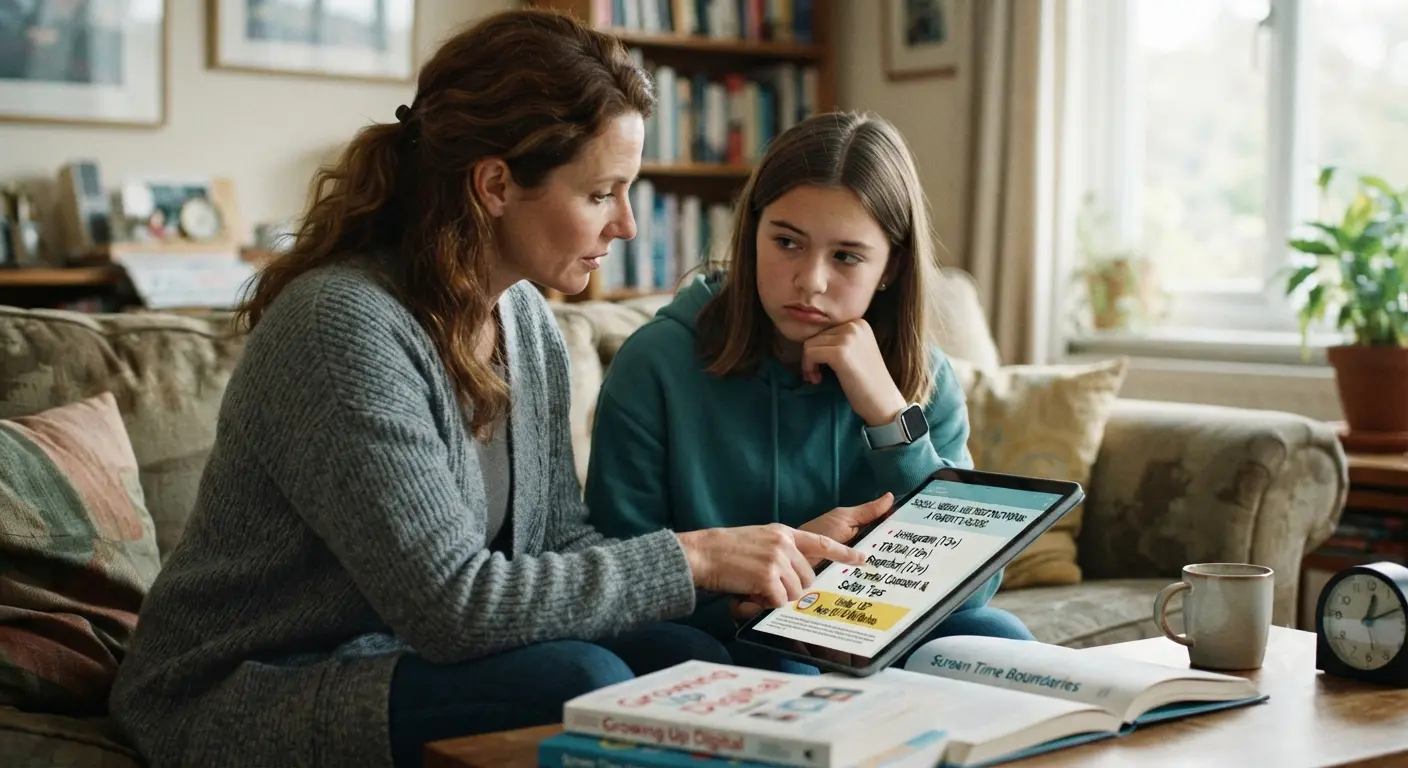
Discuss with your child
Do not make children feel as if online safety limitations are a form of punishment.
Share your concerns about online safety, privacy, cyberbullying and screen time with your child.
Establish what your child enjoys about social media. For example, they may utilise it to communicate with peers, to investigate topics that interest them and/or to feel part of social groups.
Having such knowledge can assist parents in defining suitable online engagement guidelines.
Investigate each online service’s minimum age criteria
Online services can have varying minimum ages and features.
Ensure that you are aware of the minimum age requirement for the online service(s) that you wish your child to engage with.
Even if a particular online service is widely used by teenagers, this does not necessarily mean that it is suitable for younger children.
Bear in mind that a service’s minimum age criteria and your country’s legal age restrictions are separate.
Employ parental controls
Most prominent online services contain parental controls which can be utilised to further regulate children’s online engagement.
Depending on the online service, parental controls may allow you to:
Define who can communicate with your child.
- Control commenting and engagement
- Prevent location sharing
- Block unsuitable content
- Implement daily screen-time alerts
- Utilise family parental control tools to regulate privacy
Parents can also use device-level controls built into a child’s phone or tablet. If you want an additional way to set boundaries on distracting apps, review the BlockerX social media blocker and compare its features with your family’s needs.
On an iPhone or iPad, parents can use Settings > Screen Time to manage limits and restrictions.
For Android devices and Google accounts, parents can consider Google Family Link, subject to device and account requirements. It provides parent-managed tools for a child’s account and device.
See Apple’s current parental-control instructions.
Read about Google Family Link.
Define and agree screen-time controls
In order to balance life, children need time for education, rest, physical activity, leisure, and in-person socialising. For families working on routines around online content, see the related BlockerX guide to practical ways to stop doomscrolling.
Establish realistic family screen-time guidelines.
These may include:
- No social media use at mealtimes
- No phone use during homework
- No non-essential online engagement before bed
- Where possible, store devices outside bedrooms overnight
- Engage in regular offline activities
Nevertheless, it is also crucial to consider not only how much, but also the nature of children’s online engagement.
Educate children regarding online strangers and manipulation
Inform your child that not everyone that they interact with online is necessarily who they represent themselves to be.
Children should never:
- Share their address or location with strangers
- Email or message unfamiliar people photographs
- Provide passwords or verification codes
- Meet someone that they have engaged with online, in private
- Obey the demands of an individual who is either threatening or attempting to manipulate them
Show children how they can terminate communication, block individuals and preserve evidence of threatening messages. Furthermore, emphasise that they can and should seek assistance.
Above all, ensure that your child knows that they will not face reprimand for informing you of any unpleasant online experiences.
Supervise children’s online engagement, without eroding trust
Whilst it is important for parents to supervise their children’s online engagement (especially for younger children), covertly reading your child’s communications or frequently inspecting their phone can cause a loss of trust.
It is preferable to transparently define how you will supervise your child’s online engagement. Explain the type of parental controls that you will implement, and why such supervision is necessary. Moreover, demonstrate how greater privacy can be afforded to your child as they demonstrate suitable online behaviour.
Ideally, online supervision should be for both safety and educational purposes.
Identify if a child is inappropriately engaging with social media
Be alert to whether your child:
- Is excessively perturbed by separation from their phone
- Spends an abnormally high amount of time scrolling online
- Is especially affected by the number of likes, comments and/or followers that they receive
- Prefers to engage online rather than participate in family activities
- Conceals their social media accounts
- Demonstrates altered emotional states as a result of online engagement
- Loses enthusiasm for previously enjoyed activities
Whilst this does not automatically signify that a child is digitally addicted or suffering from a mental health issue, it is important to initiate dialogue so that you can recognise what may be occurring.
Promote in-person relationships and interests
Should parents impose online safety guidelines without offering suitable alternate activities, children may find themselves feeling isolated or left out.
Parents can therefore foster their children’s real-life relationships by encouraging participation in pursuits such as sport, music, books, visual art, the outdoors and/or socialising.
Children benefit from opportunities to enhance their interpersonal skills, self-confidence and emotional strength, alongside their independence, in the offline realm.
Model appropriate digital behaviour
Sometimes, parents expect children to discontinue their online engagement, despite persistently checking their own phones.
Children learn by observing adults.
If for example, you scroll through social media throughout mealtimes, or break off conversations in order to respond to notifications, and/or dedicate every evening to watching short videos, your guidance may seem contradictory.
Develop family-wide digital guidelines.
Remove your phone from use during discussions. Further, institute periods of no-screen time and show children that fun can be had in non-screen formats.
How to Implement Parental Controls
Parental controls can be utilised to reinforce family digital guidelines.
iPhone and iPad: Apple Screen Time
Parents can use Apple Screen Time to regulate children’s app, communication and content engagement and website access.
Apple’s menu labels vary by iOS version and Family Sharing setup. For a child’s account, the current route may begin at Settings > Family > [child’s name] > Apps & Websites; on other setups, use Settings > Screen Time on the parent or child device. Follow Apple’s current parental-control instructions for your version.
- Open the child’s Screen Time or Family settings.
- Choose the available content, app, web, and privacy restrictions and review the allowed or blocked lists.
- Set app limits or a schedule for Downtime, while keeping essential communication available.
- Use a parent-managed Screen Time passcode where supported, and tell your child what boundaries are in place and how to ask for changes.
- Review the settings together periodically and test that they work on the child’s devices.
Parents can also analyse statistics to assess children’s app engagement levels.
Android: Google Family Link
Google Family Link enables parents to oversee a child’s Google account and Android devices.
Depending on the device and account setup, parents can regulate their child’s screen-time, approve or refuse app downloads, control app engagement, impose content controls, analyse device engagement and set device Downtime.
Find out more about Google Family Link.
Social Media Parental Controls
Online services such as Instagram, TikTok and YouTube provide a range of tools which can be utilised by parents to oversee children’s online engagement.
For instance, Instagram and TikTok both provide Family Centre and Family Pairing respectively. These can be used by parents to regulate specific areas of children’s online engagement.
Again, parental controls should not be seen as a substitute for age restrictions. They should instead be combined with suitable online engagement guidelines and open dialogue.
What If My Child Sets Up a Covert Social Media Account?
This is often one of parents’ greatest worries in implementing social media age restrictions.
Children may falsify their age, utilise another person’s account and/or use different devices and/or online services.
Parents should avoid responding to covert social media engagement with anger as this may further encourage children to continue to hide their online engagement.
Follow the steps below:
- Identify the motivation for your child setting up an account
- Discuss the minimum age requirements of the relevant social media service
- Outline the risks of misstating one’s age
- Investigate whether your child feels peer-related pressure or fears that they may miss out
- Define suitable digital guidelines with your child
- Together, analyse the account and social media service rules
- Continually revisit this discussion
Explain local rules calmly and accurately. In Australia, the minimum-age obligation applies to covered platforms; the eSafety Commissioner states that children and parents are not penalised for the child’s account under this law.
Ultimately, parents should endeavour to educate children regarding suitable digital behaviour.
Can Social Media Age Restrictions Ensure Children’s Safety?
Age restrictions may limit access to specified services, but they cannot remove every online risk or guarantee that a child will be safe.
Children may then engage with alternative online services such as communication provision, gaming, video-sharing and/or other online offerings.
Furthermore, children can also be exposed to unsuitable information via search engines, websites, adverts and hyperlinks.
In addition, there are issues to be addressed in relation to age verification, privacy and false age information. There are also challenges in ensuring that young people can effectively access genuine support networks.
Therefore, social media age restrictions need to be viewed as just one element of a wider strategy to enhance children’s online safety.
Successful online safety promotion involves several connected parts:
- Responsible online services and privacy-conscious age checks.
- Age-appropriate settings, safer design, and clear reporting routes.
- Open family conversations, digital literacy, and trusted adult support.
- Practical device and app boundaries that are reviewed as children mature.
No single rule or control can replace the others. Social media age restrictions under 16 are one part of a broader approach that balances safety, privacy, development, and children’s need for connection.