Pornography and Body Image – 7 Evidence Based Facts
Research, body confidence and media literacy
In this article
- 1. Understanding body image
- 2. Key findings from systematic reviews
- 3. Why comparison may occur
- 4. Consumption and problematic use
- 5. Diversity and the lack of a singular ‘ideal’
- 6. Strategies to minimise comparison
- 7. When to receive professional support
People commonly ask whether pornography can impact someone’s body image. Although there are associations between pornography and body image, it is not evidenced that all individuals will become insecure as a consequence of watching.
Whilst pornography differs in many respects (such as type, performer and situation) individuals will also interpret this material based on various factors including, but not restricted to; their history, identity and relationships. Differentiating between problematic and non-problematic pornography consumption is key. Equally, distinguishing between correlation and causation is essential.
Here I summarise key information from systematic and longitudinal research. I then describe why and in what ways individuals may compare themselves to media and what to do if this is then affecting self-confidence. This article is not a diagnosis and is not commenting on an individual’s sexuality.
1. Understanding body image
Whilst body image can encompass an individual’s thoughts, emotions and behaviours around their body, sexual body image focuses on how one perceives their body in a sexual setting. This may relate to someone’s level of comfort and/or perception of their genitalia and/or self-confidence in relation to a partner.
Not all of these areas of interest will apply or translate equally. For example, research into general body image may not reflect someone’s body image in an intimate situation. Likewise, research examining men’s body image may not equally or directly relate to women and/or gender diverse people. Always ensure that you can identify the people researched and what was analysed within any newspaper headlines relating to pornography and body image.
2. Key findings from systematic reviews
Pornography and body image: what research finds
A systematic review of 26 studies which can be searched on PubMed analysed the links between pornography consumption and body image and sexual body image. The review concluded that there was correlation between levels of pornography consumption and negative body image for heterosexual men and women. However, research was limited in relation to adolescent and sexual minority people so generalisation of results should be approached with caution.
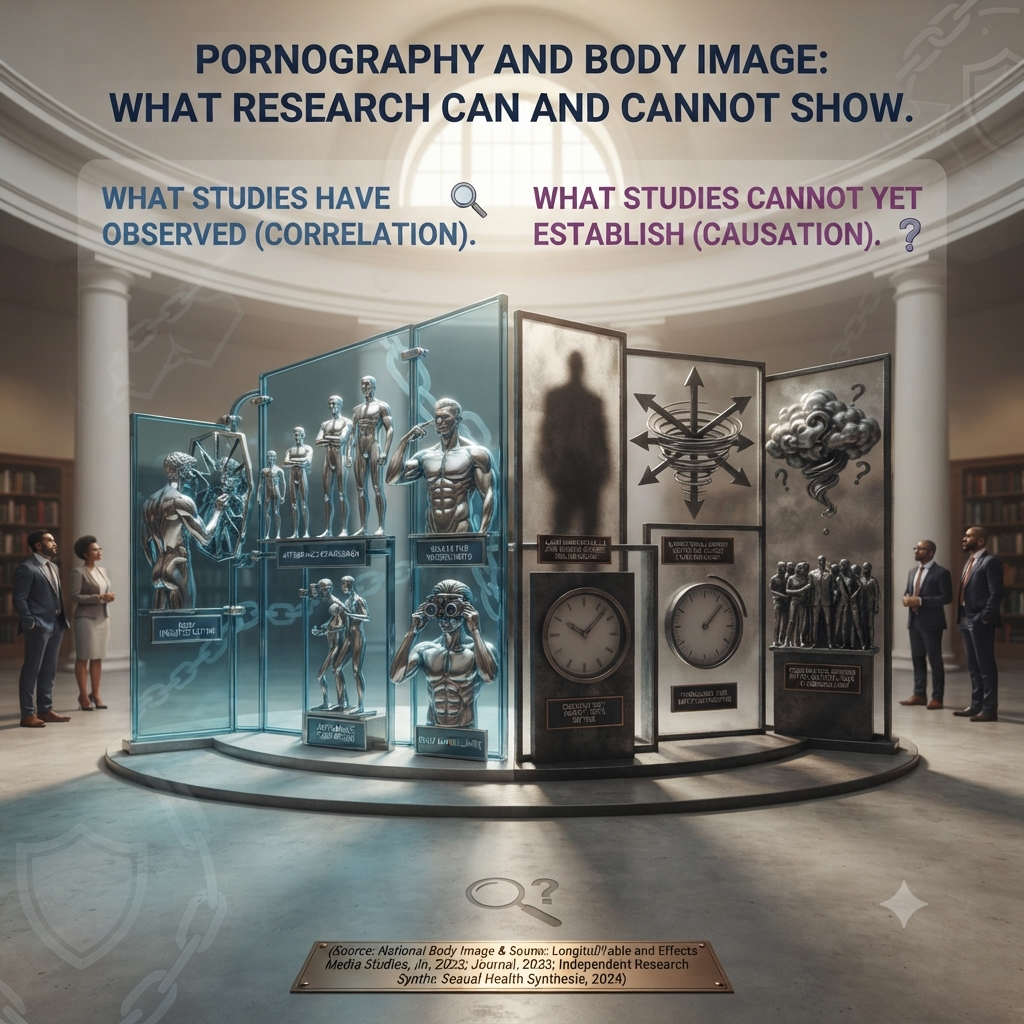
Although this review compiles results from numerous studies, it is important to recognise that it illustrates a correlation. It cannot, in itself, demonstrate that consuming pornography has led to negative body image. Differences exist in methodology, population and definitions. Therefore, although this review is valuable, further research and discussion is encouraged. Findings should not be considered as universally applicable.
Recent research has helped to further differentiate between variables. One study of 726 men undertaken in 2024 discovered that problematic pornography consumption (but not just high levels of consumption) was correlated with increased social comparison. This was then associated with negative body image. Despite this, it was not proven that watching pornography led to this. It does however highlight that whilst both problematic use and consumption levels are important, these should not be considered as one and the same issue.
A one year study of 2801 Hungarian adults undertaken in 2025 found positive correlations between problematic pornography consumption and body dissatisfaction in both male and female participants. Within this study’s modelling, body dissatisfaction and problematic pornography consumption were found to associate with each other over time. This is a superior method of analysing change compared to cross-sectional data. However, the research is still observational so alternative contributing factors may exist and cause and effect cannot be definitively highlighted for all individuals.
Overall we can conclude that some individuals report body image issues, which they attribute to media comparison influenced by pornography. Correlations have been identified, and further research should be undertaken. Again, research has not evidenced that all people will necessarily suffer body image issues simply as a result of pornography consumption. Nor can it be inferred that an individual’s insecurities definitely stem from pornography.
3. Why comparison may occur
Although many media items are knowingly produced, styled and edited for a target audience, an individual may still compare themselves to them. Someone may compare their body shape, appearance, sexual confidence and/or performance to that shown. Even where a media item is not an accurate reflection of typical bodies and/or intimate situations, a person may still feel strongly that they should compare themselves to it.
Moreover, media comparison can be focussed on one aspect. People can ignore wider media production information, for example; diversity among performers and the fact that media is shot for visual effect. If an individual continually uses media as a benchmark for their body, they may become less satisfied with how they appear and/or may fear judgement by a partner.
This is one potential mechanism. The aforementioned 2024 men’s study showed a statistical correlation between problematic pornography consumption and body dissatisfaction via social comparison. Again, this does not confirm causation. Other research has shown correlations too, though the populations and results analysed can differ. Additional research, including with differing genders, sexual orientations, ages and cultures, should continue.
4. Consumption and problematic use
As noted above, consumption relates to how often someone consumes media. Generally, problematic use is thought to occur when an individual feels that they lack control over their consumption and/or that this is causing adverse impacts. Although these two areas can coincide, they are not the same.
For the 2024 study, consumption levels were not found to correlate with its analysed social comparison and body image outcomes. However, problematic use did correlate with these. Importantly, this research only looked at men. Therefore, although this is valuable, we should avoid over emphasising that nobody’s body image is ever impacted by their consumption levels.
Furthermore, body dissatisfaction can itself affect media consumption. People’s media behaviour may also be influenced by other elements such as depression, anxiety, discrimination and/or relationship difficulties. Alongside this, an individual’s general media exposure can be significant. When an individual recognises that their self-confidence is being affected, a clinician can facilitate analysis of the wider background context behind this and avoid attributing a singular cause purely based on newspaper headlines.
5. Diversity and the lack of a singular ‘ideal’
As previously mentioned, pornography is not representative of either bodies or relationships. Content is produced, directed and displayed in accordance with decisions made by performers, producers and even audiences. Someone utilising pornography to determine what their body ‘should’ look like may be basing this on a limited selection of bodies, which is furthermore likely to be influenced by commercial interests.
Whilst writing media literacy articles, it is also important not to substitute one singular ‘ideal’. Individuals do not need to wholly dismiss all media or adhere to a specific political stance in order to look after their body image. More appropriately, an individual can ask themselves whether the media they engage with is providing them with useful and/or comfortable information or whether it regularly prompts them to compare and then negatively evaluate themselves.
What resonates for, and what media is consumed by, an individual can also be affected by personal, media and situational factors. Some people watch pornography and are unaffected by its impact on their body image. Conversely, others compare themselves to it or are negatively affected. An individual’s perspective is important. Population data is also key in avoiding unwarranted generalisations.
6. Strategies to minimise comparison
If you are finding that media (for example pornography) is impacting on your body image, you may find it helpful to experiment with a number of strategies.
- Identify what you are comparing yourself to. This could be your body, body shape, genitalia, sexual excitement, endurance and/or confidence.
- Recognise that media is constructed. It does not represent all bodies or dictate sexual activity or a partner’s expectations.
- Observe how you feel following media engagement. Do you feel neutral, interested, engaged or more self-critical? Analysing trends in responses to different media will typically yield greater insights.
- Decide what media to consume. Avoid types of media which are consistently linked to heightened self- comparison. Furthermore, you may wish to intermittently disengage from media and observe how this affects your mood and/or body confidence.
- Broaden your media consumption. Access quality sexual health information and media which represents a more diverse range of bodies and relationships. Again, avoid using pornography as a source of sexual health and/or relationship advice.
- Employ body neutral language. Whilst you may not be able to maintain perpetual positive attitudes towards your body, you can focus on what your body enables you to do and/or on aspects which aid your body’s wellbeing. Body neutrality can often be a more achievable approach than constantly maintaining positive body-related thoughts.
- In relation to your relationships, speak to a suitable partner regarding your media-related body image concerns. There is no requirement for your partner to confirm that you have a specific body type. Open, respectful dialogue can be effective in clarifying expectations and boundaries.
Please note that these are suggestions. Whether or not you wish to reduce or cease media consumption can form part of your self-care. Where primary body image concerns are present, it may also be valuable to address these directly, rather than automatically attributing them to media behaviour.
7. When to receive professional support
People should access professional support for their body image if it is highly preoccupying, if it is adversely affecting their diet or exercise, if it is making them feel unsafe in their relationships or if it is negatively impacting on their educational, occupational and/or other relationships. Qualified mental health professionals can analyse underlying factors and then advise on suitable support. If you have immediate physical or mental health concerns, please contact a qualified healthcare professional.
Seek someone who can discuss body image and sexuality in a non-judgemental manner and who does not automatically assume a particular moral viewpoint. You can investigate a professional’s experience in relation to body image and their approach to, and analysis of, media including pornography. You are under no obligation to use, or even recognise, the term ‘addiction’.
Should someone find that they struggle to manage their pornography consumption, this too should be discussed. As mentioned above, research distinguishes between problematic use and consumption. Professionals can analyse an individual’s body image and behaviour, again without pre-conceived ideas about whether one has caused the other. BlockerX’s blog post exploring pornography and depression also investigates a further area of mental health. However, this should not be used as evidence that pornography leads to depression and/or body dissatisfaction.
Common misconceptions
- Pornography always leads to poor body image.
- Frequency of pornography consumption indicates that there is a problem.
- Correlation demonstrates that pornography has led to insecurity.
- Only females compare themselves to pornography performers.
- Everyone must instantly love their body.
- People can develop respectful and less reprimanding attitudes to their bodies, without needing to constantly hold positive views towards them.
Frequently asked questions
Does pornography affect body image?
Some studies and reviews show that there can be correlations between pornography and body image. However, again, these can vary depending on what and who is analysed. It has not been evidenced that all people will necessarily suffer body image issues as a result of pornography.
Can pornography lead to body insecurities?
Some people do become insecure and/or compare themselves to pornography. Others do not. Should you identify that this is occurring for you, you can modify your media consumption and access support. However, again, this does not have to universally apply.
Is high pornography consumption equivalent to problematic use?
No. Consumption is concerned with how often someone engages with pornography. Problematic use generally involves an element of perceived uncontrollability and/or adverse impacts. Research can demonstrate differing connections between these two areas.
What does research tell us about pornography and body dissatisfaction?
Systemic and observational research has established correlations. For example, one 2025 one year study analysed young adults. Additional research should continue. However, straightforward cause and effect relationships cannot necessarily be identified and results are not universally applicable.
What can I do if I am comparing myself to media and this is affecting my relationships?
Identify the nature of the comparison. Avoid media which exacerbates such comparisons. Additionally, you may want to discuss this in a non-judgemental way with a partner. Should continued negative impacts or impacts on daily life occur, then a mental health professional can provide support.
Conclusion
Evidence shows that there can be correlations between pornography consumption and/or problematic use and some body image issues. Specifically, social comparison and body dissatisfaction have been linked in certain populations. Nevertheless, this evidence does not judge all individuals. Differences in analyses and populations exist and observational research cannot conclusively show that an individual’s feelings were solely caused by pornography.
Should you find that you are becoming more self-critical as a result of engaging with media, you can alter your media consumption. You can also widen and improve the quality of sexual health information that you access. Speaking to someone you trust can also be helpful. Should ongoing or significantly adverse impacts exist, a qualified professional can support you in understanding the wider context. Everyone is entitled to non-judgemental professional support.